Showing posts with label C Programing. Show all posts
Polish Mathematics of prefix, postfix , infix expressions & Algorithms
Tag :
Algorithms
,
C Programing
,
Data Structure
,
Polish Mathematics
,
postfix & infix expressions
,
prefix
,
Stack
Polish notation
The grate polish mathematician came up with a new technique for representation and calculation of arithmetic expression where operator will be before or after the operand called polish notation.Normal expression A+B
Prefix +AB
Postfix AB+
Infix A+N
Example questions --
convert the following expression to prefix & postfix{[(A+B)/C] *(D-E)}
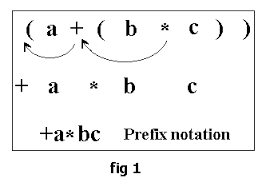 Prefix
We have to solve above expression according to the priory of operatorsFirst we solve the brackets
={[(+AB)/C]*(-DE)}
={[/+ABC]*(-DE)}
={*/+ABC-DE}
Prefix expression is */+ABC-DE
Postfix
={[(AB+)/C]*(DE-)}
={[AB+C/]*(DE-)}
={AB+CD/DE-*}
=AB+CD/DE-*
postfix expression is AB+CD/DE-*
Algorithms for converting infix to postfix using stack
- Add a unique symbol # into stack and add it in the end of array infix. A*(B+C^D)-E^F #
- Scan the symbol of array infix one by one from left to right.
- Symbol is left parenthesis '(' then add it to the array.
- Symbol is operand then add it to array postfix.
- Symbol is operator then pop the operator which have same priority or higher priority then operator which occurred .
- Add the pop operator to array.
- Add the scaned symbole into stack.
- Symbol is right parenthesis ')' then pop all the operator from the stack.
- Symbol is # then pop all the symbol from stack & add them to array except #.
- You ave done it .
For example .

Infix expression is A*(B+C^D)-E^F
A*(B+C^D)-E^F #
| Symbole | Stack | Postfix expression |
| A | A | |
| * | * | A |
| ( | *( | A |
| B | *(+ | AB |
| + | *(+ | AB |
| C | *(+ | ABC |
| ^ | *(+^ | ABC |
| D | *(+^ | ABCD |
| ) | * | ABCD^+ |
| - | - | ABCD^+* |
| E | - | ABCD^+*E |
| ^ | -^ | ABCD^+*E |
| F | -^ | ABCD^+*EF |
| * | -* | ABCD^+*EF^ |
| ( | -*( | ABCD^+*EF^ |
| G | -*( | ABCD^+*EF^G |
| / | -*(/ | ABCD^+*EF^G |
| H | -*(/ | ABCD^+*EF^GH |
| ) | -* | ABCD^+*EF^GH/ |
| # | ABCD^+*EF^GH/*- |
We would like an interactive session. Comment your question below.
Be Updated Be safe !
Cheers !!
Introduction to Data structure
Data structure is a way to organized data in some way so that we can perform operations on the data in effective way.Some examples are listed below.
- Link List.
- Stack.
- Queue.
- Tree.
- Graph.
- Hash Table.
1) Size of data.
2) Amount of data.
For Implementing Data structure We need to understand Dynamic Memory Allocation
Pointers - A pointer is variable which contain the memory address of another variable.
Declaration Of Pointer variable -
int a; // Normal variable Declaration
int *a; // Pointer Variable Declaration
Operators Of Pointer -
- & - Address Operator
- * - Value at the address operator
Example of Pointer -
#include<stdio.h> // Header files
Void main()
{
int a=5;
int *p ;
p = &a ;
printf("\n %d",a); // 5
printf("\n %d",p); // address 25001
printf("\n %u",&a); //25001
printf("\n %u",&a); // 25002
printf("\n %d",*p); // 5
printf("\n %d",*(&a)); // 5
return 0;
}
Dynamic Memory Allocation

- sizeof()
- malloc()
- calloc()
- free()
sizeoff()
The size of operation is use to find the size of argument in terms of byte . the argument can be variable or any data type.
Example.
int a[10] ;
sizeof(a); // 20
sizeof(float); // 4
malloc()
This function is use to allocate the memory space.
Syntax - ptr =(data type *) malloc( specific size) ;
Example.
ptr =(int*) malloc(10) ;
Calloc()
This function is used to allocate the multiple blocks of memory.
syntax - ptr = (int*) calloc( number of block , size of block ) ;
Example.
ptr =(int*) calloc ( 5 , 2) ; // this allocate 5 blocks , each of 2 bytes
free()
This function is use to release the memory spaces.
Syntax - free(ptr);
Example.
free(ptr) ; // memory set to free
we would like to have an interactive session. comment your questions below.


